

Toddlers are small packages with big feelings. They’re the human equivalent of a self-inflating lifeboat with unknown contents; revealed only upon spontaneous detonation nowhere near water, negating any capacity to save anyone.
Particularly since it’s filled with nothing but fireworks, wet paper and circus sawdust.
The cute descriptor we have for “one who toddles” comes from the Scots. It was first used the same year Louis XVI was executed and assured never to walk unsteadily again. Prior to that, kids were generally considered wilful and used as household servants.
It’s a pity only one of those ideas endured.
Mostly they behave like Louis XVI; ruling over a centralised state revolving entirely around them, living well beyond their means and being boorishly indecisive. Obviously they don’t lose their heads – that’s their parents’ job.
Reason has no place in the world of one-to-three-year-olds. It’s a designated space for paranormal determination, and routine upheaval thanks to an aberrant colour, or formerly familiar fruit committing a heinous crime by its sheer presence.
Their lack of meaningful contact with reality would deem them certifiably insane, were it not for the widely accepted term “childhood”.
Living with a toddler is a relentless hostage situation in which you are the hostage. Stockholm syndrome is a state of being.
Ensuring your own survival is exclusively reliant on theirs. It involves inner and outer perimeter control, advanced negotiation tactics as well as being able to both ignore, and name threats.
Extreme demands are commonplace. De-escalation skills and the ability to determine best alternatives to negotiated agreements are de rigueur.
And that’s just to find the shoe they had on a minute ago when you’re already fifteen minutes late. It’s lucky they have big eyes, weird little voices and hilariously tiny digits.
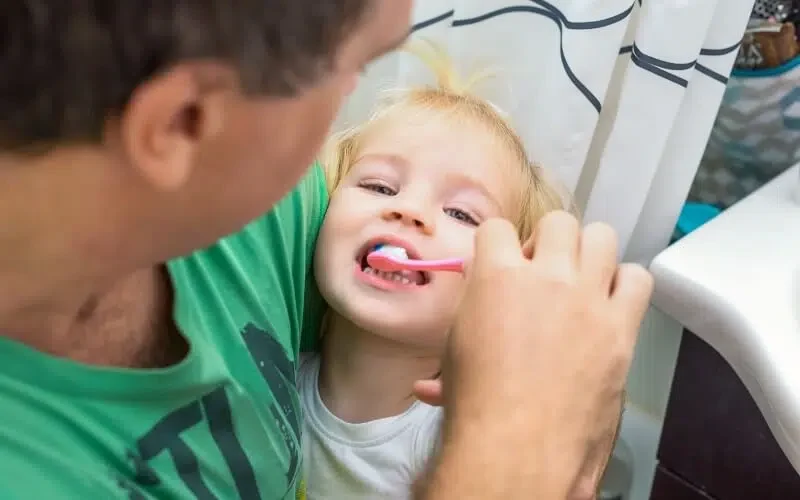
Wrangling a toddler to brush their teeth twice a day is one of the most tediously thankless tasks in the mounting mound of all the others. It’s not one (or two) you can overlook – the rest of their life depends on it. Poor oral health is one of the greatest dividers of those who get ahead, and those who are almost relentlessly challenged academically, socially and financially.
Whether it’s fair or not, people are judged by their teeth. Not having confidence in your smile is life-altering. The pain of instilling a good dental health regimen into a small child is the gain of a lifetime of self-worth and well-being. Almost 30% of three-year-olds have at least one cavity. By the time they’re 5, almost half have already experienced tooth decay.
That’s unacceptable, really.
Considering there’s plenty of focus on getting them the technology and toys they want. Time with a toothbrush is so much more important: routinely, and absolutely without compromise. Their first dental appointment needs to be around age one, when all their milk teeth have finally arrived. It’s not a practice set – their permanent teeth can be affected by the health of their first.
There were guidelines advising avoiding fluoride toothpastes for children under the age of two, but that’s since been reconsidered to improve cavity protection.
Choose the right sized small, soft manual toothbrush. Electric ones need to wait until they’re at least three years old because of the lack of control they have with it, and the damage they can cause to their gums. Brush up on your own techniques – there’s no point showing your toddler things that are fundamentally wrong. You won’t be doing that when you’re teaching them to drive.
Without making it complicated, let them know that brushing their teeth has to be done in the morning and before they go to bed and what it entails. Let them watch you brush yours, show them on a doll, draw pictures – whatever it takes, do it. Have a toothpaste flavour they like even though they don’t need much.
An appointment with the dental hygienist is always worth it. It takes the pressure off you, kids often behave better for other people and you’ll probably learn something really useful.
There’s plenty of stuff readily available if you’re not confident in what you’re doing, or if the methods you’re trying aren’t exactly working. What can’t happen, is that you simply give up because it’s too hard – that’s just pitiful.
Make sure it’s not some 20-second cursory, pretend attempt you’re happy with where every participant gets a prize. For them to be dedicated, you have to be. Find a two-minute song or make one up. Either way, it’s two minutes of toothbrush action, regardless of how much whingeing might go on in between. Making it a huge bribe-fest is likely to be really counterproductive. What are you going to give them – a lolly?
There are some things kids have to realise they’ve just got to suck up and spit out and this is a really good one for that. If you want at least one guaranteed thing your kids will thank you for when they’re older, this is it.
Celebrate it now with fireworks, wet paper and circus sawdust …